
Angel Investors vs Venture Capital: Which Funding Path Is Right for Your AI Startup?
Most AI founders think they’re deciding between angel investment and venture capital. In reality, they’re deciding what kind of company they want to build.
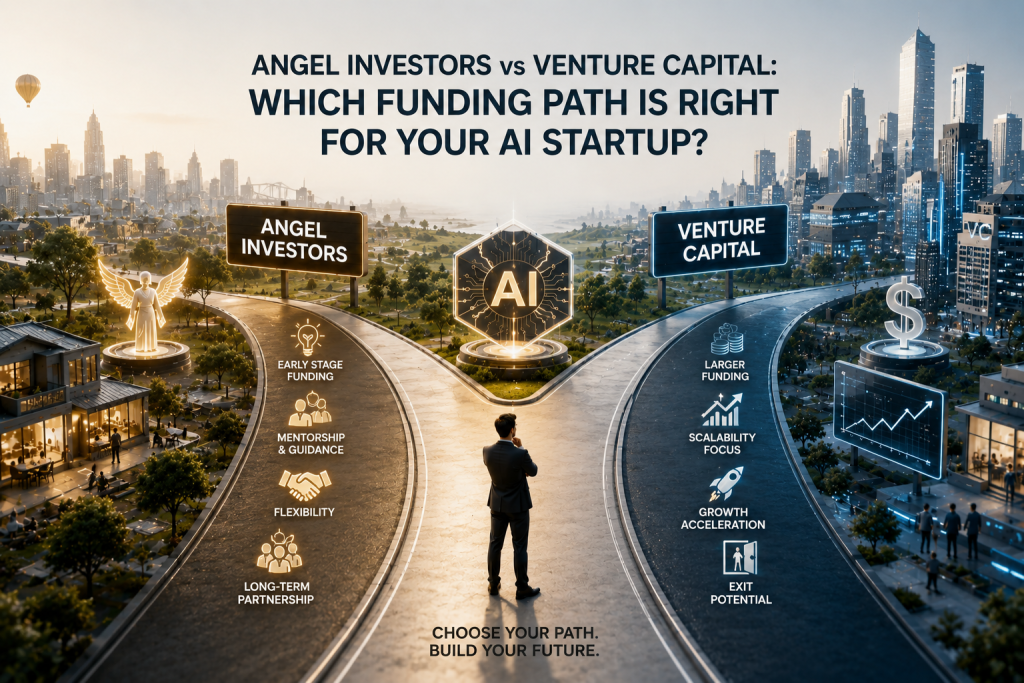
Every AI Founder Eventually Faces This Question
Angel Investment vs Venture Capital Isn’t the Real Decision
- Do we need capital to accelerate growth?
- Do we need industry expertise?
- Do we need enterprise customers?
- Do we need regional expansion?
- Do we need credibility with future investors?
- Or do we simply need better strategic guidance?
Why AI Startups Have Different Funding Needs
- AI engineers and specialised talent
- GPU infrastructure and cloud computing
- Proprietary datasets
- Enterprise implementation
- Product development
- Regulatory compliance
- Regional expansion
Understanding the Two Paths
Angel Investors: Helping Founders Find Their Footing
- Industry introductions
- Commercial advice
- Product feedback
- Founder mentorship
- Access to future investors
- Strategic perspective
Best suited for businesses that:
- Are refining product-market fit
- Need industry introductions
- Want experienced mentors
- Require strategic guidance
- Are raising relatively smaller rounds
Venture Capital: Accelerating Proven Businesses
- Growing revenue
- Product-market fit
- A scalable business model
- Clear expansion plans
- Strong execution capability
- Regional and international networks
- Governance experience
- Board participation
- Follow-on funding
- Institutional credibility
Best suited for businesses that:
Which Funding Path Fits Your AI Startup?
Three AI Businesses. Three Different Funding Decisions
Scenario 1: AI LegalTech
Real-World Perspective
Companies such as Harvey and Luminance have shown that success in LegalTech is driven by more than strong AI capabilities. Enterprise adoption, credibility within the legal profession and trusted relationships with leading law firms have been just as important as the technology itself.
Scenario 2: Healthcare AI
Real-World Perspective
Scenario 3: Enterprise AI & AI Services
Real-World Perspective
Singapore-based Temus has demonstrated how enterprise AI businesses can scale by working closely with organisations undergoing digital transformation. Their growth reflects another path for AI companies—one built on execution capability, trusted partnerships and long-term enterprise relationships rather than relying solely on venture funding.
The Common Thread
Four Mistakes Founders Commonly Make
1. Raising Because Everyone Else Is
2. Optimising for Valuation Instead of Strategic Value
3. Choosing Capital Before Building Relationships
4. Solving the Wrong Problem
- A distribution partner
- An experienced operator
- A board advisor
- A legal specialist
- An AI expert
- A customer introduction
- Capital is only one possible solution.
